A Public Consultation Is Not a Vote
A public consultation is not a vote: see what each process can tell decision-makers, using a hypothetical local transport proposal to trace the difference.
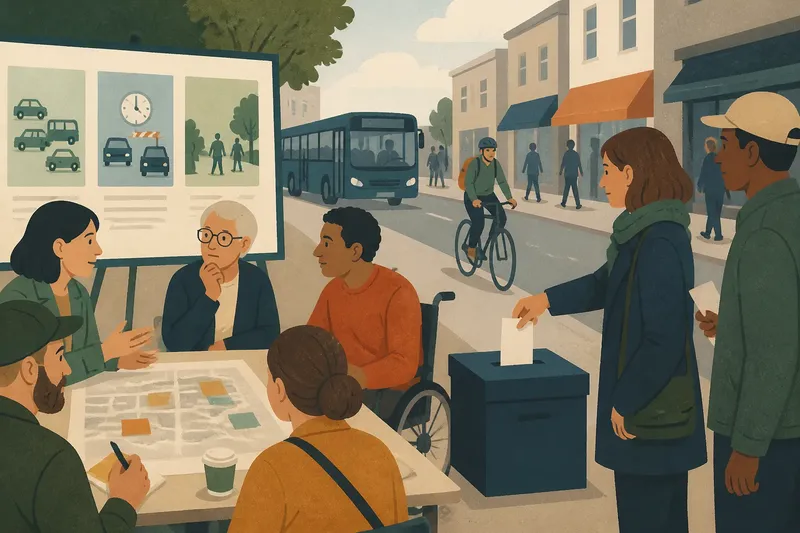
A public consultation is not a vote, even when a council asks residents to choose among several options. Imagine a borough considering what to do with a busy town-centre street: the decision-makers need to know what people think, but also why they think it, what consequences they have noticed and which groups may be affected differently. Consultation and voting can each supply useful evidence. They answer different questions.
What is the council trying to decide?
In this invented situation, a borough council is reviewing a street used by buses, delivery vehicles, pedestrians and people cycling. It has three possible approaches: retain the current arrangement, restrict through-traffic at selected times, or create a largely pedestrian area. The council has not settled the design or decided which groups’ concerns should carry most weight.
It begins with a public consultation. Residents, traders, visitors and transport users are invited to comment on the options and explain their priorities. The council also asks people to identify practical problems the proposal may have missed, such as access for a mobility vehicle or the timing of deliveries.
A later vote could ask eligible voters to select one of the three approaches. That would produce a clear count of expressed preferences among those who voted. It would not, by itself, explain why the winning option appealed, whether voters understood the trade-offs, or how a change might affect people who did not take part.
The distinction resembles the difference between asking someone to choose a dish and asking what ingredients they can eat. A choice gives a decision; an explanation can reveal a need that the menu did not anticipate.
What can consultation reveal that a vote cannot?
Consultation allows people to respond in their own words, within the scope set by the organisers. A resident might support reducing through-traffic but warn that the proposed bus diversion leaves a care facility difficult to reach. A shopkeeper might prefer the current layout while asking for a more reliable loading period. Those comments can expose design questions as well as preferences.
That information is useful only if the council treats responses as material to assess, not as an automatic instruction. It can compare comments with the proposal, seek further technical advice, check whether an issue affects a particular location and explain which changes are feasible. It should also say what falls outside the consultation’s remit. A request to improve bus frequency, for instance, may be relevant to the wider transport decision even if the immediate proposal concerns street access.
Consultation responses do not necessarily represent the whole population. People who reply may have strong views, more time, better access to the process or a direct stake in the outcome. A large pile of comments can therefore show what respondents said without establishing how common a view is among everyone affected. The wording of the questions, the available options and the channels for responding also shape the evidence.
In the hypothetical borough, a consultation could reveal that supporters of pedestrian access disagree about delivery arrangements. It could also show that some opponents object to the timing rather than the principle. Those distinctions give the council something a simple tally cannot: reasons it can use to revise or clarify the proposal.
What does a vote establish?
A vote is designed to record choices under defined rules. A ballot can ask voters to choose between proposals, approve or reject one question, or rank options, depending on the voting system. The result can establish which choice received the most support among ballots counted under those rules. It does not automatically establish public agreement on every detail.
For the borough, a vote might settle a clearly framed question such as whether to restrict through-traffic at selected times. If the choice is binding, the decision-maker may be required to follow the result. If it is advisory, the council can treat the count as evidence while retaining responsibility for the final decision. The distinction should be clear before people are asked to vote.
A ballot makes it harder to tell why a person chose an option. Someone voting for the pedestrian area may prioritise safety; another may want a quieter street; a third may expect more customers for local businesses. A vote counts those preferences together without separating their reasons. Nor does a win necessarily mean that voters endorse every implementation detail that follows.
Turnout and eligibility matter to interpretation. A result describes the choices cast by people entitled to take part who actually voted. It should not be casually described as the view of every resident, every affected person or the entire public. The rules, question wording and legal status determine what the count can properly mean.
How should the council use both kinds of input?
Consultation and voting need not compete. In this invented case, the council could first consult on the problems and possible designs, revise its options, and then hold a vote if it wants a public choice between clearly specified alternatives. It could also decide that the decision is not suitable for a ballot, while still publishing a careful account of consultation responses.
The order matters. If a vote happens before the options are explained or made workable, the result may give a crisp answer to an unclear question. If consultation happens after a decision has effectively been made, people may reasonably doubt that their comments can influence anything. The council should state what is open to change, who will decide and when a response will be published.
To make consultation evidence easier to assess, organisers can:
- Describe the decision and the matters that are already fixed.
- Present each option in comparable language, including its main trade-offs.
- Offer accessible ways to respond, including formats for people who cannot use an online form.
- Ask for reasons and practical impacts, not only support or opposition.
- Record who was invited and consider whose experiences may be missing.
- Publish a response explaining which suggestions changed the proposal and why others did not.
These steps do not turn consultation into a representative survey. They make its limits more visible and its contributions easier to use. If the council needs to estimate how widely a preference is shared, it may need a separate method designed for that purpose rather than treating consultation replies as a substitute.
What questions should residents ask before taking part?
Is the consultation asking for a preference or for evidence?
Check whether the form invites reasons, local knowledge and proposed changes, or simply asks you to choose an option. If it asks for evidence, describe the location, affected journey or practical consequence as clearly as you can.
Who will make the final decision?
Look for an explanation of whether the council, elected representatives or another body will decide. The process may gather public views without transferring the decision to participants.
Will the result bind the decision-maker?
A vote may be binding or advisory, and a consultation is generally a way to inform a decision rather than a ballot. Read the stated rules so you know what the result can require and what it can only influence.
How will responses be reported?
Ask whether the council will publish themes, explain its reasoning and distinguish consultation submissions from a representative count. A transparent account helps readers see both what the process captured and what it left uncertain.
What should the result tell the public?
Suppose the hypothetical council receives comments supporting fewer cars, alongside concerns about deliveries and access, then holds an advisory vote in which one option receives the most ballots. It could report the vote’s result, describe the consultation themes, explain how the design changed and identify concerns that remain unresolved. It should not claim that the consultation itself produced a public mandate, or that a winning ballot answered every question about implementation.
The useful lesson is to match the claim to the method. A consultation can help decision-makers understand reasons, impacts and overlooked details; a vote can record choices under stated rules. A public consultation is not a vote, and neither process can speak for people it did not reach. When you read the result, look for the question asked, the people included and the decision the evidence is being used to support.
That distinction also gives residents a practical way to participate: cast a ballot when a defined choice is put to you, and use consultation to explain what the options conceal. The strongest public decisions are easier to scrutinise when officials show how each kind of input shaped the choice they ultimately made.