Following a Shared River Through International Institutions
Following a shared river through international institutions shows who handles data, pollution and water allocation, and how to read their different roles.
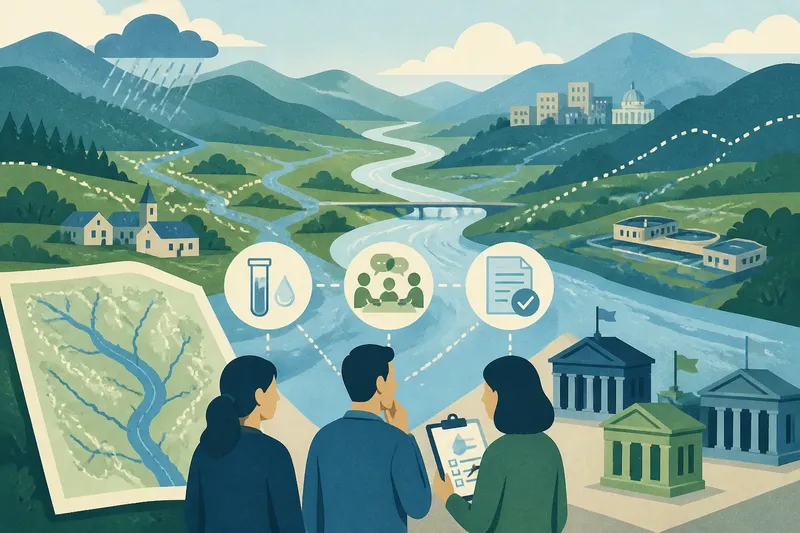
Following a shared river through international institutions starts with a practical question: who is responsible for which part of the water’s journey? A river crossing a border may be discussed by national ministries, a joint commission, local authorities and scientific bodies, each with a different remit. Tracing those roles helps separate routine coordination from binding decisions and public debate.
For a reader, the challenge is not to memorise every organisation. It is to choose a route through the material that matches the question at hand. You can follow the river basin, follow a particular issue such as water quality, or follow a decision from its local effects back to the institutions involved. Each approach reveals a different kind of cooperation.
Which route through the institutions answers your question?
Begin by deciding what you need to understand. Are you asking how governments share information, who sets a policy, or what a decision means for people living near the river? These questions point to different documents and actors. Treating them as one question can make an institutional map seem more complicated than it is.
Three approaches are especially useful:
- Follow the basin: trace the river and its tributaries across borders, then identify the institutions whose remit covers those waters.
- Follow an issue: choose a subject such as flood warnings, water quality or allocation, and look for the bodies that collect information, coordinate action or make rules.
- Follow a decision: start with a public decision or announcement and trace its authority, supporting evidence and implementation across institutions.
The basin approach suits readers who want a broad orientation. The issue approach is better for a focused question, while the decision approach works when a policy change or public disagreement has prompted the search. These routes can overlap, but it is useful to choose one as your starting point rather than collecting documents without a clear purpose.
What does the basin approach reveal?
A river basin is the area of land drained by a river and its tributaries. It gives you a geographical frame that may not match national borders or administrative boundaries. A map can show where water flows, where tributaries join, and which communities and jurisdictions share a connected system.
That geography matters because a measure taken in one place can affect conditions elsewhere. A downstream community may rely on information gathered upstream. A flood warning may require authorities on both sides of a border to exchange observations. The basin view helps explain why cooperation exists even when responsibilities remain divided among governments.
To use this approach, begin with a reliable map from a public water agency, river-basin organisation or geographic authority. Note the river’s main course and tributaries, then look for the names of any basin-wide body and national agencies. Search those names alongside the river’s name and terms such as “basin plan”, “joint monitoring” or “water management”.
Next, check the institution’s geographic remit. A body may cover only a section of the river, selected tributaries or a particular activity. Do not assume that an organisation with the river’s name oversees every issue affecting it. Its founding agreement, mandate or official description should tell you what territory and responsibilities it covers.
This route is useful for school or newsroom backgrounders, for readers approaching an unfamiliar river, and for anyone trying to understand why several countries appear in the same policy discussion. It is less direct if the real question concerns a single rule, a dispute over access or the practical effect of a recent decision. In that case, the map is a starting point, not the whole answer.
When should you follow a single issue?
Issue-based tracing narrows the search to a subject that crosses institutional boundaries. Water quality, drought planning, flood forecasting, navigation and allocation can involve different agencies, even within the same basin. The advantage is focus: you can see how a particular public concern is handled without trying to catalogue every organisation connected to the river.
Choose a clear issue and identify the work involved. For water quality, for example, separate monitoring from standard-setting and enforcement. A laboratory or environmental agency may collect samples; a ministry may set policy; national authorities may apply domestic rules; and a joint body may compare information or coordinate shared objectives. Similar names do not mean identical powers.
Look for documents that explain the task each institution performs. Useful material includes monitoring protocols, basin plans, meeting agendas, technical reports and public notices. The document type can help you tell whether you are reading evidence, a proposal, a formal decision or an account of implementation. Check who issued it, who it addresses and whether it describes an agreed position or one party’s view.
Say you are trying to understand a reported concern about water quality on a river shared by two countries. You could begin with the relevant basin body’s monitoring page, identify which national agencies supply observations, then compare the latest public report with each agency’s stated responsibilities. That route should make it clearer whether the material describes shared data collection, a common policy aim or separate national action. It does not, by itself, establish that a particular source caused the concern.
This approach suits readers who have a defined question and want to know how cooperation works in practice. It also helps prevent a common confusion: an institution that coordinates information may not have authority to compel a national agency to act. The distinction between coordination and decision-making is often more informative than the organisation’s title.
What can a decision-led route show?
When a public announcement raises questions, start with the decision itself. Find the original statement, resolution, plan or official notice rather than relying only on a headline or a summary. Record the institution that issued it, the date, the decision-making body and the language used to describe its status.
Then trace the chain behind it. Ask what authority the institution says it is using, which other bodies contributed, and what happens next. A joint commission might recommend action, adopt a shared plan or publish a record of discussion; those are not interchangeable. A domestic ministry may then need to take separate action under national procedures.
Read the wording closely. “Agreed”, “endorsed”, “recommended” and “implemented” point to different stages and levels of authority. A public statement can also combine a firm decision with unresolved questions. If it names a timetable, responsible agency or follow-up meeting, use those details to locate the next relevant document rather than treating the announcement as the end of the process.
The decision route is suited to readers following a policy change, an intergovernmental disagreement or a claim that cooperation has succeeded or failed. It keeps attention on authority and consequences. Its limitation is that a single decision may not explain the wider basin, the underlying science or the everyday work of exchanging information.
Which documents and institutions should you look for?
International river cooperation often involves several layers, and their names can sound alike. A bilateral commission may bring together two governments. A basin organisation may cover several countries or a defined catchment. National water, environment, agriculture or foreign-affairs ministries may handle separate domestic responsibilities. Local authorities and utilities can manage services or respond to conditions within their jurisdictions.
Scientific and technical bodies add another layer. They may monitor flow or water quality, maintain shared datasets, assess risks or offer advice. Their expertise can inform public decisions without giving them authority to make those decisions. A report’s technical value and its legal or political status are separate questions.
For each body, try to locate four pieces of information: its mandate, its membership, the area it covers and the work it actually performs. Official statutes, agreements and institutional descriptions can establish formal responsibilities. Meeting records and work plans can show how those responsibilities are being used. Public-facing summaries are helpful, but check whether they link to primary documents.
Think of the institutions as labels on folders in a shared filing cabinet: each folder holds a different kind of responsibility, even though all concern the same river. The analogy is useful only up to a point. Unlike folders, institutions may share tasks, disagree about evidence or rely on one another to carry decisions into effect.
How do you choose the right approach?
Use the basin route when you need to understand the river’s geography and the broad network of cooperation. Choose the issue route when you have a specific concern and need to distinguish data collection, coordination and policy. Follow the decision route when your main question is who authorised an action and what that action changes.
A simple test can help: write your question as one sentence, then identify the kind of answer it needs. If the answer needs a map, start with the basin. If it needs a comparison of institutional functions, start with an issue. If it needs the authority and status of a particular action, start with the decision. Change routes only when the first one leaves a clear gap.
Keep a small working note as you read. Record the organisation’s full name, its remit, the document you consulted and what that document does not establish. This keeps a technical report from being mistaken for a policy decision, or a meeting summary from being treated as proof that a plan has been carried out.
What questions help distinguish the roles?
Does a joint river commission make binding rules?
Its authority depends on the agreement or legal framework that established it. Check its mandate and the wording of its decisions; some commissions coordinate or advise, while others may have defined decision-making powers.
Who is responsible for monitoring water quality?
Monitoring may be carried out by national agencies, technical bodies or a shared programme. Look for the organisation named in the monitoring protocol and distinguish the collection of samples from the interpretation and publication of results.
Can local authorities take part in international river cooperation?
They may contribute local information, manage services or participate in consultation, depending on the arrangements in place. Their involvement does not necessarily mean they represent a national government or hold authority over the whole river.
Where can I check what a river agreement actually requires?
Start with the agreement’s official text and any later protocols or implementation documents. If the consequences depend on legal interpretation or local rules, consult a qualified professional or the relevant public authority.
How can you keep the account accurate?
Use neutral language that reflects the source. If one institution says it “coordinates” a response, do not rewrite that as “controls” it. If governments disagree, describe the stated positions and the point of disagreement rather than implying that the shared institution has resolved it.
Separate three questions in your notes: what is known about the river, what institutions have agreed, and what action has been taken. Those categories can overlap, but a technical finding is not itself an agreement, and an agreement is not the same as implementation. The distinction gives readers a clearer account of what cooperation has achieved and what remains unsettled.
Following a shared river through international institutions is most useful when the route matches the question. Start with the geography, a specific issue or a particular decision; then check each institution’s remit against its documents. That habit turns a crowded list of organisations into a readable account of who gathers knowledge, who coordinates across borders and where public authority sits.