The Work Between a Treaty Signing and Its Next Step
The work between a treaty signing and its next step shows what states must do before international promises become binding rules and public policy.
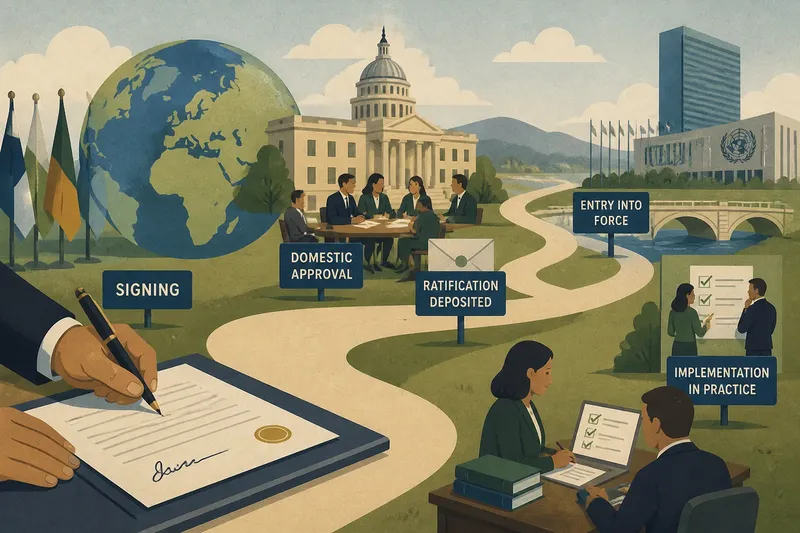
What happens after countries sign a treaty? The work between a treaty signing and its next step can include domestic approval, formal ratification, entry into force and the practical arrangements needed to carry out its promises. Signing makes a political commitment visible; it does not necessarily make every provision legally binding or immediately applicable.
The route varies by treaty and by each country’s constitutional rules. These stages are best understood as separate decisions, not as one long formality. Here are seven points to watch when a signing ceremony is followed by weeks or years of less visible work.
1. What does the signature commit a government to?
A signature records that a state has completed negotiations and accepts the treaty text as the agreed version. It is a meaningful diplomatic act: changing the wording later is no longer simply a matter of reopening informal talks. But signature alone does not always count as a state’s final consent to be bound.
In many treaty processes, signatories are expected not to undermine the treaty’s purpose while they decide whether to ratify it. That limited expectation differs from being bound by all the treaty’s detailed duties. The distinction matters in public debate: “the government signed” is not automatically the same claim as “the treaty now applies in full”.
Check the treaty’s own final clauses for the terms it uses. It may allow ratification, acceptance, approval or accession, each describing a formal route by which a state expresses consent. The text also identifies where that instrument must be deposited and what conditions govern the treaty’s entry into force.
2. Why does the text have to go through domestic approval?
International agreements are made between states, but their approval often depends on institutions at home. A constitution may give a legislature a role, require an executive decision, or divide authority between national and regional bodies. The relevant procedure depends on the country and sometimes on the subject matter of the treaty.
Domestic approval is not merely a second signing ceremony. Legislators may examine whether existing law is compatible with the treaty, whether new legislation will be needed and what obligations public agencies would have to carry out. They can also debate the political trade-offs, including costs, administrative demands and the effect on national decision-making.
A treaty’s obligations and domestic law are related but not identical. In some systems, a ratified treaty can be applied in domestic courts in certain circumstances; in others, legislation is needed before officials or residents can rely on its provisions at home. A public statement that a country has “approved” a treaty therefore does not, by itself, tell you what a person can claim under local law.
3. What is ratification, and how does it differ from approval?
Ratification is a formal act through which a state confirms its consent to be bound, following the process set out in the treaty and its own law. The word is often used loosely in news coverage, but the legal act is usually a document or notification sent by an authorised government representative to the designated depositary. The depositary may be a government or an international organisation responsible for receiving and recording treaty instruments.
Domestic approval and international ratification can happen at different points. A legislature might consent first, after which the government completes the international procedure. Or a government may sign, wait for internal review, and later decide not to ratify. Each step has its own significance; collapsing them into “the country has joined” can obscure what remains undecided.
The treaty may also permit reservations or interpretative declarations. A reservation is a state’s stated intention to exclude or modify the legal effect of particular provisions in its application of the treaty, where the treaty and applicable rules allow it. A declaration can explain how the state understands a provision without necessarily changing its legal effect. These details can affect how other parties understand the agreement and what commitments are shared.
4. When does the treaty actually enter into force?
Entry into force is the point at which the treaty becomes legally operative under the conditions written into its text. It might begin after a specified number of states have deposited their instruments, on a stated date, or separately for each state after that state completes its own procedure. The treaty’s final clauses—not the ceremony—provide the answer.
These conditions create a practical difference between the first ratifying states and those still considering the agreement. A treaty can enter into force internationally once its threshold is met while a later ratifier becomes bound only according to the rule that applies to it. Some treaties also have provisional application: participating states may agree to apply certain provisions before full entry into force, subject to the agreement’s terms.
For a reader following the process, check the depositary’s official status record. It can show signatures, ratifications, accessions, reservations and the date on which the treaty entered into force. That is more informative than relying on a headline that treats signing as the final stage.
5. What has to happen before officials can put the agreement to work?
Even when a treaty is in force, its promises may require a domestic implementation plan. Governments might need to pass legislation, amend regulations, assign responsibilities to agencies, set up reporting procedures or arrange how different levels of government will coordinate. The treaty sets the shared commitment; institutions decide how to translate it into authorised action.
Implementation is not necessarily a single act. A ministry may need to issue guidance, train staff, create a process for receiving applications or establish how it will collect information required by the treaty. Other duties may depend on appropriations, technical standards or cooperation with another country. The public can ask which body is responsible and what formal instrument gives it authority.
Imagine a treaty requiring participating states to notify one another before taking a particular cross-border administrative action. After ratification and entry into force, officials might still need a designated contact office, a secure notification channel and a domestic rule explaining which department must send the notice. The observable next step would be a published procedure identifying that office and its responsibilities—not simply another statement of support.
6. How are differences and disputes handled after entry into force?
Treaties often include ways for states to monitor compliance or settle disagreements. Depending on the agreement, parties may submit reports, meet in a joint committee, exchange information or refer a dispute to negotiation, arbitration or a court. These mechanisms are not interchangeable: some assess progress, while others can address whether a party has breached a legal obligation.
Monitoring bodies can make the treaty’s operation more visible. They may ask governments for information, compare implementation plans or issue recommendations. A recommendation is not automatically a binding ruling, and a reporting process does not necessarily have power to impose a penalty. Read the treaty text and the body’s mandate before treating a public finding as a court judgment.
States can also disagree over interpretation without immediately abandoning the agreement. The treaty may set out consultation periods or a sequence for resolving disputes. Following that process helps show whether a disagreement is being managed within the agreed rules or is becoming a wider diplomatic dispute.
7. What changes can come later, and how can readers track them?
Some treaties allow amendments, protocols or later decisions by the parties to develop particular rules. An amendment may need its own approval and ratification process; a protocol can add a separate set of obligations for states that join it. A conference of parties may also adopt decisions within powers the treaty has already granted. These routes differ, so “the treaty was updated” is not enough to explain the legal effect.
For a clear account, follow the documents in order: the signed text, the domestic approval record, the instrument of ratification or accession, the depositary’s status information, and any implementation legislation or official guidance. Then check whether the treaty has a reporting body, a review meeting or a procedure for amendments. This trail is rather like tracking a parcel through separate delivery scans: each record answers a different question, and no single scan tells the whole story.
In diplomatic coverage, the phrase “after the treaty signing” is a prompt to ask what stage comes next, who has authority to take it and what record will show that it happened. The work between a treaty signing and its next step is not an administrative footnote: it is where a visible promise is tested against legal procedures, public institutions and the practical capacity to act.